


Hotel marketing has changed significantly in recent years. What was once a straightforward mix of OTA partnerships and paid advertising has evolved into a far more complex discipline. Success today depends on combining digital visibility, data-driven personalisation, and B2B distribution rather than managing them in isolation.
Hoteliers are under pressure to rethink which strategies truly drive demand and long-term profitability. The rise of AI-powered discovery, shifting traveller behaviours, and fragmented channels are forcing a fundamental reset.
This article explores how marketing in the hospitality industry is evolving, which digital marketing strategies are proving most effective, and why B2B hotel marketing is becoming essential for demand generation.

The defining shift in hotel marketing today is the move from isolated tactics towards connected marketing ecosystems.
SEO, paid media, distribution, and CRM once operated in silos. Today those boundaries are dissolving. Visibility, discoverability and demand generation now happen across multiple touchpoints simultaneously.
A traveller might discover a hotel through a short-form video, validate it via AI-powered search, then book directly after a personalised email offer. No single channel works alone, and this reality is reshaping what a hotel marketing plan needs to contain.
Léo Moulinas, Marketing & Digital Presence Director at HBX Group, frames the relationship simply: "Marketing and hotel distribution are two sides of the same thing. One will basically compound or provide the compounding effect for the other."
Hotels relying on a single source of demand are increasingly exposed. The properties performing best are those building visibility across multiple channels while keeping distribution connected, measurable and commercially aligned.

Digital marketing strategy for hotels is becoming more sophisticated as AI changes how travellers search, compare, and book. The landscape has shifted well beyond traditional search optimisation, and hoteliers who fail to adapt risk losing visibility before a traveller reaches any search results page.
Felipe Bravo, Head of Digital Marketing at Roiback (part of HBX Group and an award-winning HotelTech company specialising in direct channel services for hotels), identifies the priorities that will define hotel digital marketing in the period ahead. "In 2026 and 2027, hotel digital marketing is being reshaped by AI-driven discovery and privacy-led automation,” he says.
Felipe points out that “growth will come from being found in AI-powered searches, personalising the direct channel with first-party data, and measuring performance beyond last-click attribution."
One of the most significant transitions in digital hotel marketing is the shift from traditional SEO to generative engine optimisation (GEO).
When a traveller asks ChatGPT, Gemini or Google AI Overview for hotel recommendations, the result is a curated answer, not a ranked list of links. Hotels absent from those responses risk losing awareness at the most influential stages of the customer journey.
"We are moving from optimising for search algorithms to optimising for language models,” explains Felipe. “Hotels that don't appear in generated responses will disappear from a new visibility layer that is becoming increasingly influential during the inspiration and consideration stages."
Between 40% and 55% of consumers now use AI-powered search to inform travel decisions – and visitors arriving via large language models convert up to four times better than traditional organic search traffic.

Beyond GEO, hotel pay-per-click marketing remains essential for properties competing in high-demand destinations.
Google Ads (specially Performance Max Ads) and Meta Ads continue to drive results when combined with AI-powered bidding and full-funnel measurement. The right mix, however, depends on the property type.
Independent and boutique hotel marketing tends to perform best with Paid Search and Google Hotel Ads, complemented by CRM to maximise repeat bookings at lower cost.
Resort marketing strategy relies more heavily on TikTok, Meta and YouTube, where video-first formats inspire travellers before a search query is ever made.
Urban and business hotels benefit most from Search, Demand Gen and lifecycle CRM to manage occupancy through seasonality.
First-party data underpins all of these hotel marketing techniques. As third-party signals disappear, hotels that capture and activate their own data are better positioned to personalise offers and reduce reliance on intermediaries.
This is precisely where Roiback plays a key role: supporting hoteliers with booking engine technology, website optimisation, CRM integration, and digital marketing services designed to strengthen the direct channel and achieve conversion rates of up to 20%.

As digital channels become more competitive, B2B hotel marketing is gaining strategic importance for visibility, demand generation and long-term performance.
In simple terms, a B2B marketing strategy in hospitality involves positioning a property within professional travel ecosystems, connecting hotels with travel agents, tour operators, OTAs, wholesalers and corporate travel partners.
Rather than replacing direct or digital strategies, it complements them by expanding visibility across the wider travel value chain.
Léo explains the dynamic clearly: "Hotels are diversifying their investment into more B2B-oriented channels, influencing not the end travellers directly, but the intermediary – the travel trade. This complements what's being done through B2C channels very nicely."
B2B marketing also gives hotels access to bookers who purchase repeatedly and at volume – travel agents, tour operators and OTAs transacting on behalf of multiple clients – creating a compounding effect that direct bookings alone cannot replicate.
The commercial case is compelling. As Léo points out, “within HBX Group's B2B media network, Sponsored Listings can generate an estimated 70x return on investment. So, every €1,000 invested translates into approximately €70,000 in transactions, providing concrete proof that B2B channels deserve a meaningful share of any hotel marketing budget.”

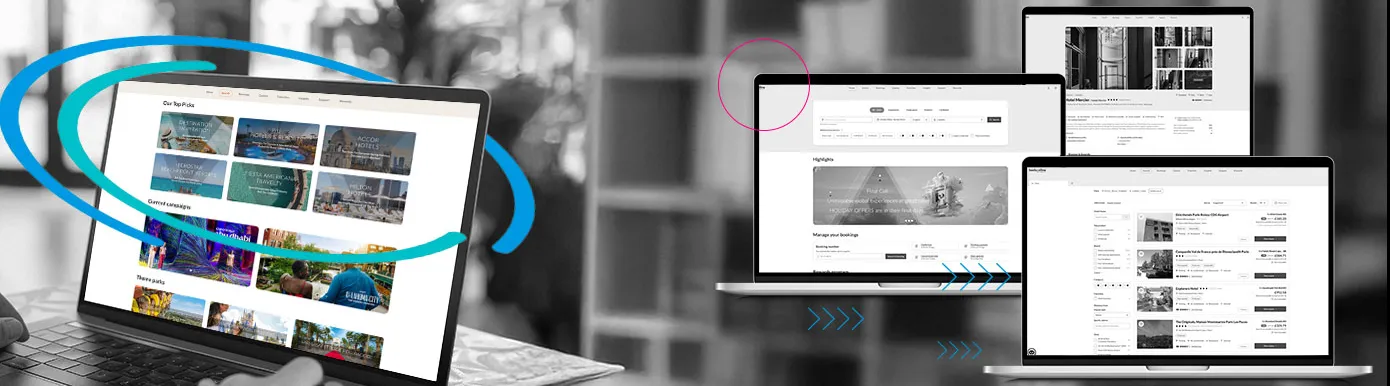
The HBX Group Marketing Suite offers hoteliers a full-funnel approach to visibility and demand generation across B2B channels.
It includes display advertising, sponsored listings that rank properties prominently within booking engine search results, and offline marketing opportunities at HBX Group events such as the MarketHub, which brings together 500 of the company's leading clients per region.
Creative services are also playing an increasingly important role in hotel visibility strategies, particularly as traveller discovery shifts towards video-first and social-led environments. As Léo explains, “Gen Z in particular takes video content as a huge source of inspiration,” reinforcing the growing importance of authentic, platform-native creative assets within both B2B and B2C campaigns.
Through AI-powered video production and creator-led content formats, these creative services help hotels improve engagement and influence travellers earlier in the decision-making journey.
By aligning these hotel marketing solutions with distribution strategy, the Marketing Suite helps hotels capture demand throughout the entire traveller journey.
HBX Group's global B2B distribution ecosystem connects hotels with more than 60,000 travel distributors across 135 markets through a single integration, simplifying operations while significantly expanding commercial reach.

Hotel marketing is becoming more strategic, more data-led and more interconnected. Success heading into 2027 will depend on how effectively hotels combine AI-driven visibility, digital performance, B2B distribution and first-party data activation into one coherent strategy.
"The biggest challenge for hotels is no longer just driving traffic,” says Felipe. “It is making sure the property is visible wherever travellers are making decisions, especially within AI-powered discovery environments."
Léo shares the same conviction: "A smart distribution strategy backed by clever marketing is really the winning formula to fill your hotel."
Hotels that treat digital marketing and B2B visibility as complementary levers rather than competing priorities will be best placed for sustainable growth. Hotel marketing is becoming more strategic, not more complicated.

The most effective hotel marketing strategies combine digital visibility, AI-driven discovery, CRM personalisation, B2B distribution, and direct booking optimisation. Rather than pursuing individual tactics in isolation, the hotels seeing the strongest results are those building integrated marketing ecosystems where channels reinforce one another across the full traveller journey.
Yes, but its role is evolving. SEO is transitioning into GEO – generative engine optimisation. Hotels now need to optimise not only for traditional search rankings but also for inclusion within AI-generated recommendations and conversational search environments such as ChatGPT, Gemini, and Google AI Overviews. Structured, credible, contextually rich content is increasingly what determines visibility in these new discovery layers.
The right hotel marketing channels depend on property type and target audience. Key priorities include AI-driven search visibility, paid media (Google Ads, Meta Ads, Performance Max), social and video-first platforms, CRM strategies, and first-party data activation. Independent hotels and resorts will naturally weight these differently, so building a channel mix aligned to your specific guest profile is essential.
B2B hotel marketing expands visibility across professional travel ecosystems including wholesalers, OTAs, travel agencies, and corporate networks. It complements direct strategies, provides access to high-volume bookers who transact repeatedly, and supports stable, diversified demand generation – particularly valuable during low seasons when direct demand alone may not be sufficient.
Hotels should align visibility, distribution, and conversion strategies within one connected ecosystem. Integrating direct channel marketing with B2B distribution improves discoverability, audience reach, and long-term commercial performance, ensuring that every part of the marketing mix is working towards the same goal of generating profitable, sustainable demand.
Hotels looking to improve direct channel performance can explore Roiback's digital marketing and booking engine solutions.
For broader B2B visibility and demand generation, discover how the HBX Group Marketing Suite and the wider solutions for hoteliers can help your property grow.
If you’d like to learn more about what HBX Group can offer to your property, fill in the form below and our experts will contact you to discuss any doubts.

Stay ahead of the competition! Download our free 2026 Travel Trend Report for hoteliers and discover the key insights and strategies to maximise bookings and adapt to the future of hospitality.a

 Resources